TL;DR
- Indonesia's UU 4/2026 routes every crypto trade through one licensed bursa and calls it sovereignty. It is a toll gate.
- The gate is walled twice: a one-trillion-rupiah (about $60M) capital bar, and a scarce, largely-closed pool of exchange licenses. Only incumbents and big capital get in.
- Two bourses exist, CFX and ICEx. Whether that stays a real contest or gets consolidated into one, the way the stock exchanges merged in 2007, comes down to willingness at the top, not the market.
- The wall clamps the least profitable layer, onshore spot, while the real value keeps leaving through OTC desks, offshore structures, and DeFi. A toll on the commodity, an open border on the exit.
- The framework is real and will be enforced, and it stops none of the leak. A band-aid on an amputated arm. The missing ingredient was never capability. It was willingness.
- The play for operators: do not fight the wall. Build in the grey area it has not reached, the stablecoin and tokenization rails, and become the piece the licensed bourse cannot build itself.
Sovereignty is the word Indonesia uses for routing every crypto trade through one licensed bursa. A toll gate that never maintains or widens the road is not sovereignty. It is rent on a potholed road while everyone takes the side streets. The framework is real. It will be enforced. The only question is what it is for.
The down-leg
The toll gate did not appear overnight. Back in 2020 and 2021, the playing field was globally equal. Everyone was still figuring out how to behave in Web3. DeFi summer had just made blockchain massively used for the first time, and the whole world was learning the same lessons at the same time. Indonesia was in it. NFT projects popped, exchanges grew through a crazy cycle, people explored like the ceiling did not exist. The willingness to try and build net-new was real.
Then Luna and FTX took the cycle out. Everyone got hit.
Here is where the paths split. Globally, crypto matured a lot after Luna, after FTX. Stablecoin adoption went vertical. Regulatory clarity got sharper, some of it US-driven, plenty of it not. A K-shaped recovery. And Indonesia is the leg going down.
So what happened here. Oversight moved from Bappebti (the Commodity Futures Trading Regulatory Agency) to OJK (the Financial Services Authority). Correct-ish on paper: under Bappebti crypto was only a commodity, and anyone native to this space knows crypto is more than that. Moving it to OJK lets it be treated as more than that. But a change of regulator means a transition period. And that slows everything down.
It also raises a quieter question. OJK now oversees almost the entire financial sector, banking, insurance, capital markets, pensions, and now crypto on top. Does it have the manpower and the actual understanding to steward crypto through its adult phase, or just the mandate to.
Manpower you can hire. Understanding you can grow. Willingness you cannot staff, and it is the piece in doubt. Does it die with the handover, or was it never actually there to begin with? No one knows. Either way, the result is the same: the appetite to build net-new from Indonesian founders faded, and foreign project effort here mostly dried up. That is the real story, and it is not a technology story.
Indonesia is not behind on the tech, or on the ideas. The rails work, the talent exists. What is missing sits upstream of all of it: a stewardship problem, an execution problem, a willingness problem. Every layer we are about to walk through, the bourse, the wall, the framework, is a symptom of that one thing.
The toll gate they called sovereignty
The new law puts one rule straight into statute: every crypto trade, including whatever moves through a wallet, has to route through or report to a single OJK-licensed bursa. One bursa, one order book, by law. That law is UU 4/2026, the revision of the 2023 P2SK act. Be precise about that word, because the whole argument turns on it. A bursa, or bourse, is not a crypto exchange like the ones you use. It is the marketplace those exchanges themselves must trade through, a single licensed layer sitting above retail platforms like Tokocrypto and Indodax. Now, by statute, everything passes through it. The roadmap that frames all of this names its guiding principle sovereignty.
Give the steelman its due, because there is one. A single gate means you talk to one entity instead of many. An onshore bursa with segregated customer accounts and a single-identity clearing system does lower settlement and custody risk. For anyone trying to enter, coordination gets simpler: one counterparty, one rulebook. That part is real. Worth saying out loud.
But simplification is not sovereignty. Look at what it takes to build one of these gates. The first wall is capital: one trillion rupiah (~$60,000,000) paid in, eighty percent held as equity, no single shareholder above twenty percent. Only serious money clears a door fee like that, and the twenty percent ceiling means nobody owns a bourse alone. By law it is a consortium, a club of at least five.
The second wall is who is allowed in the room at all. A bourse has to be built out of licensed exchanges, and those licenses are scarce. The pool is roughly two dozen and largely set, with new ones issued slowly if at all. A newcomer's only paths in are to buy an existing license, if one is even for sale, or to survive an application built to be hard. So a licensed bursa is not an open venue anyone can launch. It is a members' club with a sixty-million-dollar cover charge, and the membership list was mostly written before you arrived.
And here the mandate leaves a gap. It forces every trade through a licensed bursa, but nothing in it caps the number of bursas at one. So a second exists. CFX came first, in 2023. ICEx came second, licensed this January, heavily capitalized and quickly backed by a slate of the existing exchanges as shareholders, several of which also trade on CFX. On paper that is a contest, two houses instead of one. The open question is whether it stays that way. Indonesia has folded rivals into a single house before: Bursa Efek Jakarta and Bursa Efek Surabaya became one Bursa Efek Indonesia in 2007. Whether these two stay two, or get consolidated the same way, is not a market question. It comes down to the willingness of the people at the top, the same willingness this whole story keeps running into.
So you get sovereignty as the headline and a toll booth as the machine. The exit is metered. The incumbents hold the gate. Whether that is sovereignty or just rent comes down to one thing: what the gate actually does with the road.
A wall works on a commodity, not on an exit
The traffic has options. That is the whole problem with a toll booth. It only earns if the cars have nowhere else to drive, and here they do.
Start with what the wall actually corrals. In Indonesia the licensed exchanges are, in practice, on-ramps and off-ramps. Rupiah in, rupiah out. The business that pays runs over OTC desks, not the public order book. Spot barely moves the needle, which is why spot fees have raced to the bottom. More than twenty million Indonesians hold crypto, so this is not a small market. It is a low-margin one. And the low-margin layer is exactly what the single order book clamps down on.
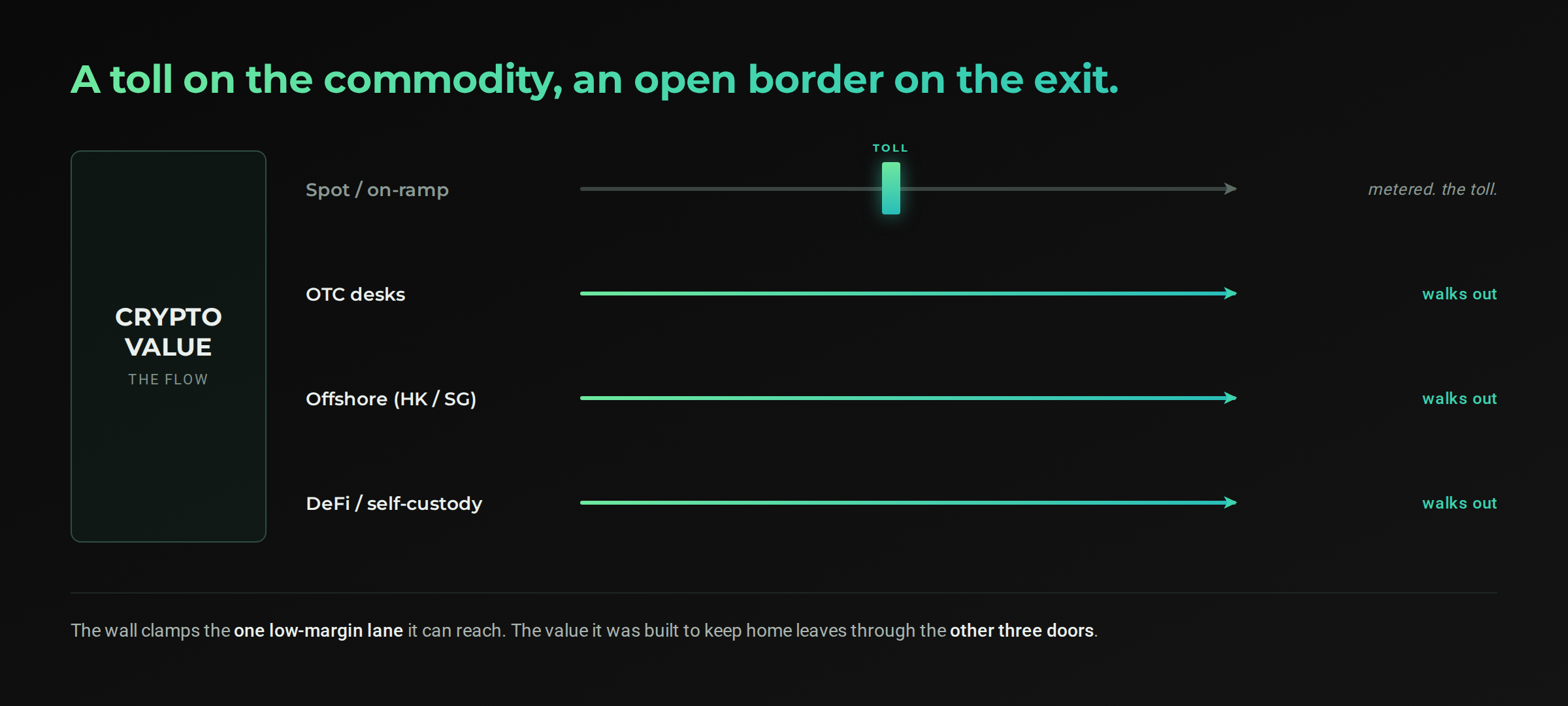
Now force everything onshore and watch both ends walk. The DeFi-native crowd does not line up at a licensed gate. They lean harder into self-custody and permissionless rails, further out of reach than before. The offshore money, the size that already sits in Hong Kong and Singapore structures, stays offshore. What is left in the middle is the licensed spot layer that was already racing itself to zero. You can wall a commodity. You cannot wall an exit.
This is the part the sovereignty framing cannot cover. To capture the value onchain, you have to build the rail or own it. Build it, co-build it, own it, co-own it, something. Indonesia has neither. Not the software to build a rail people choose, not the hardware to own the one they use. Not because the talent cannot build it, the down-leg was never about talent, but because nobody holding the mandate has chosen to. That is the willingness gap wearing a technical costume. So the value keeps leaving the way it always has. The state just stands in the middle, taking its cut on the way past. That is not capturing the flow. That is metering the leak.
So here is the honest description of the wall. It is real. And it collects on the one layer that was already the least profitable thing in the market, while the value it was built to keep at home walks out the other two doors. A toll on the commodity, an open border on the exit.
Real, enforced, and still leaking
What it is for is the only question left, and the answer is where it falls apart.
Start by granting the thing its due. Do not make the mistake of calling it paper or theater. The enabling law is already in force, and it already has teeth: freeze powers, block powers, criminal exposure for operating outside the licensed gate. The detailed rules for stablecoins, tokenization, and RWA are what OJK intends to finalize by year end. When they land, they will bind. That part is not in doubt.
But enforcement is not the same as direction. The doubt is about purpose. A framework has to be built toward something. So ask which one this is. Is it maximal protection, done the laziest way available, even if it half-kills the industry it claims to protect? Or is it built to move hand in hand with innovation, and does it actually get things closer to that? Those are two different roads. This one looks like the first.
The most generous read is that this is groundwork. Route the flow through one reporting point, stand up the surveillance and the tax base, and you have earned the right to license the harder things next: stablecoins, tokenization, the rails that actually matter. Stage one now, the good stuff later. It is a fair argument, and worth stating at full strength. The problem is that stage one is the only stage with a deadline. The reporting mandate is law, and it binds now. The rails that would justify it are intended by year end, the same by-year-end this industry has heard since the handover. When the part that binds is the only part that ever lands, at some point the foundation is the whole plan.
And here is the uncomfortable part. None of this is hard. It is not rocket science, it is simple observation mechanics. Look at what already works elsewhere, adapt it, ship it. The world has run the experiments. The missing ingredient was never capability. It was willingness.
To do what, though. Not to regulate. That part is fair: crypto is global, but local regulation of a local industry is completely legitimate, and nobody credible is arguing Indonesia should not write its own rules. What is missing is narrower: the will to do the actual job instead of the elaborate substitute for it. The single bourse, the routing mandate, the licensing maze, while the work that would move the industry goes untouched. Doing everything except the job is still not doing the job.
So the forecast, plainly. By year end the framework ships, real and enforced, and it stops none of the leak. Not one lane of the traffic from a moment ago changes course, because the wall was never built across the road the value uses. It is a band-aid on an amputated arm. Applied correctly. Changing nothing.
Here is what would prove this wrong, so it is not just a dunk. If the framework lands and it is actually built to help people build, if the offshore money starts coming home, if the DeFi-native crowd finds a licensed path worth taking, then the read here is wrong and the sovereignty was real. Watch for it. It is not the way to bet for this year.
Which puts a decision in front of anyone actually operating in this market. Not whether to comply with the gate. Where to build, now that the gate is up and the value is somewhere else.
Seek the grey area
So where do you build? Not at the wall. There is no margin left there, and no way to win a fight against a statute.
Build in the grey area instead. Here is the tell that it exists: the gate-holders are already moving into it. The licensed bourses know as well as anyone that spot is a race to the bottom, so they are reaching past it. One is pushing toward stablecoins. The other treats tokenization as the whole point. That is the space that matters, the layers the mandate has not walled yet, the layers where value actually sits.
Go there. Co-build those rails with the people who have to build them anyway. Or go one step further and build on top of them, the products that only become possible once the rails exist. This is the one move that captures instead of leaks.
Concretely: become the piece the licensed bourse cannot build itself. The settlement layer, the compliance tooling, the tokenization engine, the thing it has to partner for instead of buy. Not another exchange competing at the wall. The part of the stack the gate-holder needs and does not have. That is a position, not a pitch.
Build it, or own a piece of it. Those were the two things the country was said to lack, the software to build and the hardware to own. An operator does not have to lack them. That is exactly the gap a foreign partner or a serious local team can fill.
None of this requires beating the gate. Comply with it. It is not the fight, and it was never going to be. The real fight is in the space the gate has not reached, and it goes to whoever reads where the gate-holders themselves are heading and gets there first.
So that is the play for anyone operating in this market. Do not fight the wall. Do not pretend it is not there. Build in the room next to it, the one the wall forgot, the one filling up with everything worth having.
The toll operator
One message, then, for the side that built the wall.
If you are going to put up a toll booth and call it sovereignty, be a real toll operator. Maintain the road. Widen it. Grow the traffic that actually uses it. A toll that only collects, on the cheapest lane, while the expensive traffic drives around it, is not sovereignty. It is a booth on an empty road with a flag on top.
And none of that is the hard part. It never was. The playbook for what works already exists, written and running, in a dozen markets that did the boring version well. Read it, adapt it, ship it. What has been missing this whole time was not the capability. It was the willingness to do the plain job instead of the impressive-looking one.
That is the real choice in front of Indonesia's crypto era, and it is not a technical one. The framework will land. It will hold. Whether it turns out to be sovereignty or a costume comes down to a single decision no statute can make: actually build the road, or keep collecting at the gate and calling the leak a policy.
The leg is still going down. It does not have to be. That part was always a choice.